

Living the High Life on Italy’s Amalfi Coast
Describing Italy’s Amalfi Coast and its breathtaking scenery could easily bankrupt the English language. As you corkscrew around the corniche of hairpin turns from Sorrento to Ravello—some so sharp they demand a three-point turn—you’ll experience what’s arguably one of the most giddying, toe-clenching drives on the planet. Vertical cliffs, rising up to 300 metres, plunge into the impossibly blue Tyrrhenian Sea. Gravity-defying towns cling to the precipices, feel suspended between mountain and water, nestled amidst a landscape of terraced olive and lemon groves.
This Amalfi Coast travel guide explores one of southern Italy’s most storied landscapes, rewarding those who take their time, linger over meals, and settle into the rhythms of la dolce vita, an Italian phrase that translates to “the sweet life” or “the good life.”
The most famous towns along the Sorrentine Peninsula are Sorrento, Positano, Amalfi and Ravello, but there are several lesser-known charming fishing and mountain villages along the route. This fabled Italian Eden in southern Italy’s Campania region has been attracting visitors since the Middle Ages. Celebrities, acclaimed writers and musicians have all swooned over its considerable charms.
In 1997, the Amalfi Coast was named a UNESCO World Heritage Site because it is considered an outstanding example of a cultural landscape — a place where human life and a difficult natural environment have evolved together over centuries, rather than one overpowering the other.
Best Places to See, Stay and Eat on the Amalfi Coast
Blessed with rich volcanic soil, plenty of sunshine and a sea teeming with all sorts of fish, the Amalfi Coast is a food lover’s paradise. Try spaghetti alle vongole (spaghetti with clams) washed down with a glass of crisp white Falanghina wine. Finish with delizia al limone (lemon-scented sponge cake) with lemon zest icing. Amalfi lemons are sweeter, bigger and more bulbous than other lemons. The two types grown on the Sorrento Peninsula — the Sfusato Amalfitano and the Limone di Sorrento are among the most highly prized lemons in the world. Limoncello, the liquor that originated here, is yet another reason to toast the Amalfi Coast.
Sublime Sorrento
An hour train ride takes you from traffic-congested, noisy Naples to sleepy Sorrento, the ideal spot to start soaking up the Amalfi atmosphere. And what better place than on the terrace of Grand Hotel Excelsior Vittoria with a Bellini cocktail, where the hazy outline of Mount Vesuvius looms on the horizon? Five acres of lemon-scented gardens and white-glove service recall the bygone days of the Grand Tour, for which this Grand Dame was built in 1834.
Take a leisurely stroll through Sorrento’s medieval heart around Piazza Tasso, then head to the seafront promenade at Marina Grande, where seafood restaurants beckon. I recommend O’ Puledrone, owned by a family of fishermen, for spaghetti vongole or whatever the catch of the day.
Enjoy the tasting menu at Don Alfonso 1890 in Sant’Agata sui Due Golfi—an epicurean experience not to be missed. Reputed as the best restaurant in southern Italy and a Michelin-starred Relais & Châteaux member, it is proudly owned by the Iaccarino family. Ask to tour the cellar—once a Roman tunnel—where cheese ages and 30,000+ wine bottles reside. To extend the indulgence, book a room and enroll in a cooking class. Reservations are recommended.

View from the terrace of Grand Hotel Excelsior Vittoria, Sorrento. Photo: Anita Draycott©

Award-winning writer, Anita Draycott, swings high above the Amalfi Coast at the Raffaelle Celentano Art Gallery, Sorrento.

Catch of the day on Marina Grande, Sorrento on the Amalfi Coast, Italy. Photo: Anita Draycott©

Chef Iaccarino at Don Alfonso. Photo: Anita Draycott©
Posh Positano
A few kilometres and countless perilous turns down the road, you’ll reach Italy’s most vertical town, Positano, where pastel villas spill from the vertiginous cliffs.
I doubt they sell many StairMasters in horizontally challenged Positano, so best you leave your stilettos at home. Wind your way through the maze of boutiques and cafés down to the Santa Maria Assunta church, crowned with a green and yellow majolica dome and cupola, then head over to the Spiaggia Grande (main beach) where you’ll find some of the town’s best restaurants. Chez Black is a favourite for pasta and seafood.
Or wave down the free little boat with the red fish on its mast at the main jetty. It leaves at 10 a.m. for Da Adolfo, a casual trattoria a few coves away on Laurito Beach.
Plan an indulgent afternoon with house specialty buffalo mozzarella grilled on a lemon leaf, then seafood spaghetti. Enjoy a siesta on a shaded beach bed and sip white wine with peach nectar until the boat returns to Positano at 4 p.m.
Perhaps John Steinbeck best captured the experience when he penned, “Positano bites deep. It is a dream place that isn’t quite real when you are there and becomes beckoningly real after you have gone.”

Cliff-hanging Positano on the Amalfi Coast, Italy. Photo: Anita Draycott©
Idyllic Amalfi
Next stop is tiny, exuberant Amalfi, one of Italy’s most powerful trading ports back in the 9th century, which explains the Moorish architecture of the Cathedral of Sant’Andrea, which dominates the main square.
Treat yourself to lunch in a lemon garden at Pizzeria Donna Stella.
Shop around town for lemon souvenirs (soap, limoncello, candies, pasta) as this coast is famous for using its famous citrus in all kinds of products.
Later, join the locals in their passeggiata, a traditional evening stroll around the central piazza to socialize and perhaps enjoy a decadent pastry at the posh Panza café.
I think you’ll be inclined to agree with the inscription on a plaque under the town’s Porta Marina that bears the inscription, “The judgment day, when Amafitans go to Heaven, will be a day like any other.”

Cathedral of Sant’ Andrea dominates Amalfi’s main square. Photo: Anita Draycott©
Heavenly Ravello
I’m not going to say I’ve saved the best ‘til last because there’s hardly an inch of the Amalfi Coast that I wouldn’t rave about. However, Ravello is probably where I’d like to have my ashes sprinkled when judgment day does come.
Perched almost 350 metres above Amalfi, Ravello has been described as closer to heaven than the sea. Author and one-time resident, Gore Vidal opined that the panorama from Villa Cimbrone is the “most beautiful view in the world.” Indeed, from the Belvedere of Infinity, a stone parapet dotted with stone busts overlooking the entire Bay of Sorrento is mesmerizing and seemingly infinite. It’s no wonder that actress Greta Garbo chose this secluded garden of Eden for her romantic tryst with composer Leopold Stokowski in 1937.

Heavenly view from Villa Rufolo, Ravello. Photo: Anita Draycott©
The cloisters of the Villa Rufolo were Richard Wagner’s inspiration for Klingsor’s Garden in his opera Parsifal. The clifftop aerie is now the setting for a summer concert series, with the stage suspended over the sea.
The Villa Cimbone offers lovely hotel accommodation, but my vote goes to the Palazzo Avino, the 12th-century pink palace where Ingrid Bergman and Placido Domingo have laid their heads.
Ordinary mortals can also enjoy its sybaritic pleasures, including a rooftop solarium with Jacuzzi pools. At the hotel’s Michelin-starred Rossellinis restaurant, yachters have been known to change course and drop anchor for the chef’s gastronomic tasting menu.
If you’re craving a place with local flavour, ask the concierge for walking directions to Cumpa Cosimo, where proprietor Netta Bottone will wow you with her primi course of seven homemade pastas and sauces.

Travel writer Antia Draycott enjoys the Gardens at Villa Cimbrone, Ravello on the Amalfi Coast.
Mamma Agata’s Cooking Class
My latest Ravello discovery was my day at Mamma Agata’s Cooking Class. Mamma, one of seven children, was born in 1942, during tough post-war times. At age 13, she landed a job as a cook for a wealthy American socialite who often entertained the rich and famous in her villa. Humphrey Bogart, Fred Astaire and Jackie Kennedy all swooned over Mamma’s traditional dishes. Eventually, Mamma started offering cooking classes in the family home. These days, Mamma has passed her wooden spoon onto her daughter, Chiara.

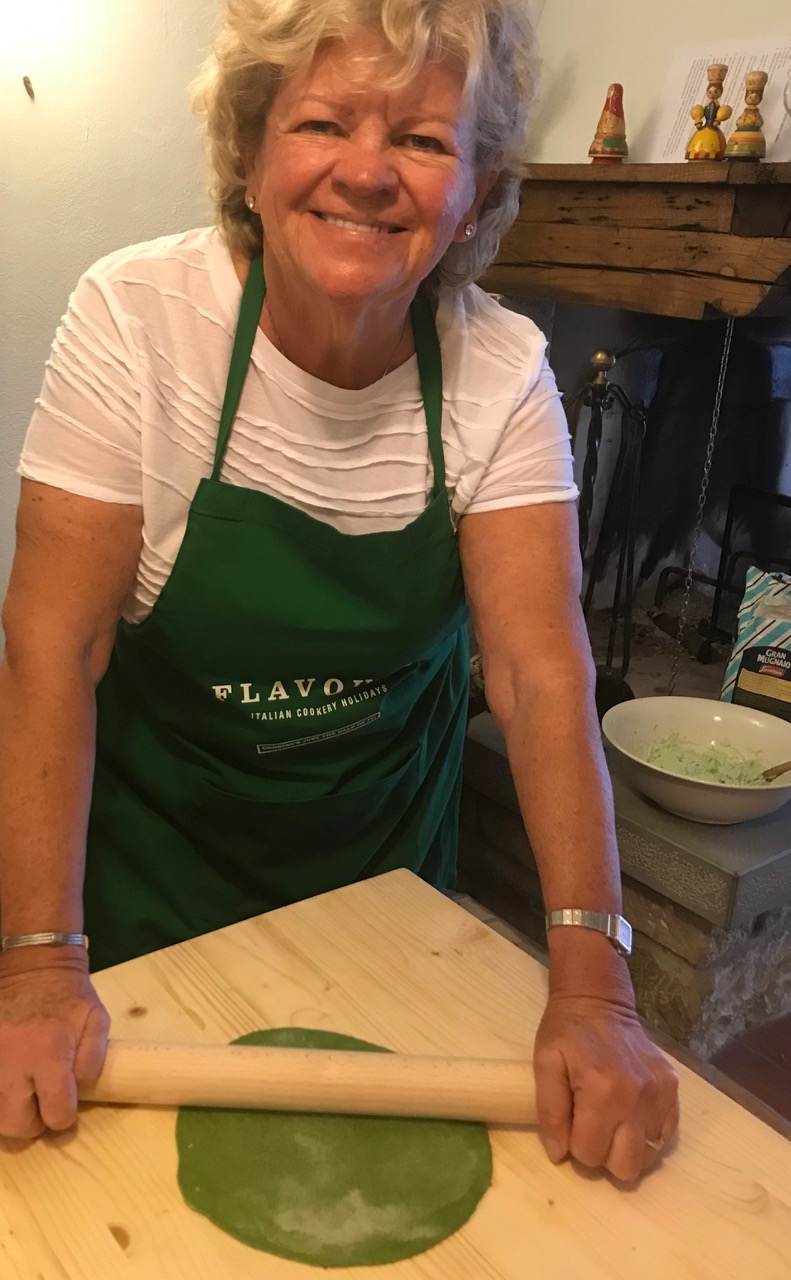
Mama Agata’s cooking class, Ravello on the Amalfi Coast. Photo: Anita Draycott©

Mama Agata’s famous lemon cake. Photo; Anita Draycott©
Our group met on the patio overlooking terraced gardens, lemon groves and the sea below. Classes start at 10:30 am with a cappuccino and Mamma’s famous lemon cake (Bogart’s favourite). Then we headed into the kitchen, where Chiara warned, “You will taste a massive amount of food.” She began by making a “mother” tomato sauce that would serve as the base for eggplant Parmesan.
Next is a Bolognese ragu that simmers for three hours. For her cherry tomato marinara sauce, Chiara dropped thin garlic slices into olive oil, creating what she calls “Prosecco” bubbles and an aroma of “Italian Chanel” filled the kitchen. Next, she demonstrated how to make meatballs “as light as clouds.”
When lunch was served, I can honestly say that each dish was the best of its kind that I have ever tasted. We toasted our feast with house-made limoncello, dubbed “Italian Viagra.”
Viva La Dolce Vita.
Mamma Agata’s Fresh Cherry Tomato Sauce Recipe
500 grams or about one pound of cherry or Roma tomatoes (or half of each).
TIP: Sweet vine-ripened tomatoes are the key ingredient. If the tomatoes are not ripe and sweet, add a spoonful of sugar.
3 tbsp extra virgin olive oil
2 cloves of fresh garlic, sliced thinly
2 tbsp fresh basil
2 pinches sea salt
2 pinches dried oregano
Add olive oil and garlic to a large saucepan. Do not heat the oil first. Place ingredients in the pan at room temperature and then heat the pan.
Chop cherry tomatoes in half; if using Roma tomatoes, chop in quarters.
Add chopped tomatoes, salt and fresh basil to the pan.
Cover the pan and cook over medium heat for 5 minutes. Add the oregano.
Cook your favourite pasta al dente, drain the pasta and add it to the sauce. Serve hot, drizzled with extra virgin olive oil.
Did You Know? Amalfi Coast Fun Facts
- The Amalfi Coast was once a powerful maritime republic. Between the 9th and 11th centuries, Amalfi rivalled Venice, Pisa and Genoa as one of Italy’s great seafaring powers — and even created the Tabula Amalphitana, one of the earliest maritime law codes used across the Mediterranean.
- Many of the Amalfi Coast’s famous lemon terraces are supported by centuries-old dry-stone walls. These hand-built structures not only prevent erosion on steep cliffs, but are now recognized by UNESCO as an important example of traditional Mediterranean agricultural knowledge.
- The iconic lemons used for limoncello on the Amalfi Coast — Sfusato Amalfitano — are so prized that they are protected by PGI (Protected Geographical Indication) status, meaning they can only be grown in specific coastal areas under strict conditions.
- Ravello sits nearly 350 metres above sea level, making it one of the highest towns on the Amalfi Coast. Its lofty position is why writers and composers — from Gore Vidal to Richard Wagner — were drawn to its quiet, cloud-level views.
- The winding coastal road that links Sorrento to Amalfi was largely carved by hand into solid rock in the 19th century. Some hairpin turns are so tight that buses use controlled traffic systems to pass safely.
Best Time to Visit the Amalfi Coast
The best time to go is from April to June or September to October, when the climate is mild, there are fewer tourists, and accommodations cost less than summer high season rates.
Getting Around the Amalfi Coast Without a Car
I have visited this enchanting corner of Campania several times and recommend travelling by SITA bus or ferry. The SITA bus system offers frequent, affordable service along the coast; a one-way ticket from Amalfi to Ravello costs about €3, compared to taxi fares starting at about €40. Buses run on regular schedules and drivers are skilled at handling the area’s winding roads, making this an efficient way to travel between towns. Ferries also operate between several coastal towns, with routes and frequency varying by season; check local timetables for current options. Renting a car is possible if you prefer flexibility, but be prepared for challenging, narrow roads and limited parking.
Subscribe to Life’s Incredible Journey for more food stories, travel guides, cultural experiences and hidden gems—delivered straight to your inbox.
👉 Join the adventure here
Search for accommodation anywhere using Booking.Com, book a sightseeing tour using Viator or a flight with Expedia and any commissions earned will help keep this website running.



Have you been here? Want to go or have other tips or comments. We'd love to hear from you.